Since April 1, 2026, every NCLEX-RN has been built from a new blueprint: the 2026 NCLEX-RN Test Plan published by NCSBN. If you studied with a review book printed before then, you may be wondering how much of it is now out of date. The short answer is very little. The longer answer matters, because the test plan is the closest thing you have to a list of what the exam is allowed to ask.
The NCLEX-RN that Canadian regulators use is the same exam written in the United States, so this plan applies whether you test in Toronto, Vancouver or Halifax. Below is what the document says, what changed from the 2023 version, and how to adjust your preparation.
Where the 2026 plan came from
NCSBN reviews the NCLEX-RN test plan every three years. The NCLEX Examination Committee recommends a plan, and NCSBN’s Delegate Assembly approves it. According to the 2026 plan itself, its content and percentages rest on the 2024 RN Practice Analysis, a survey of what newly licensed nurses actually do, plus the committee’s expert judgment.
In its 2025 summary of the proposed changes, the committee described the update in four short points: the overall format is retained, there are minor edits for currency and clarity, the Client Needs percentages are retained, and new activity statements were added. That summary also set the timeline, with the approved 2026 test plans and passing standards taking effect on April 1, 2026.
8 of 8 Client Needs content areas kept the same percentage range in 2026 as in 2023. One area was renamed.
2023 vs 2026, side by side
The table compares the eight content areas in the two plans. The 2026 ranges come from the published test plan; the 2023 column comes from the committee’s comparison table.
| Client Needs category |
Content area (2026 name) |
2023 range |
2026 range |
| Safe and Effective Care Environment |
Management of Care |
15 to 21% |
15 to 21% |
| Safe and Effective Care Environment |
Safety and Infection Prevention and Control (was “Safety and Infection Control”) |
10 to 16% |
10 to 16% |
| Health Promotion and Maintenance |
Health Promotion and Maintenance |
6 to 12% |
6 to 12% |
| Psychosocial Integrity |
Psychosocial Integrity |
6 to 12% |
6 to 12% |
| Physiological Integrity |
Basic Care and Comfort |
6 to 12% |
6 to 12% |
| Physiological Integrity |
Pharmacological and Parenteral Therapies |
13 to 19% |
13 to 19% |
| Physiological Integrity |
Reduction of Risk Potential |
9 to 15% |
9 to 15% |
| Physiological Integrity |
Physiological Adaptation |
11 to 17% |
11 to 17% |
Two details in the plan help you read those ranges. First, the plan states that an individual exam may differ by up to 3% in each category, so your own exam will not match the midpoints exactly. Second, Management of Care (15 to 21%) and Pharmacological and Parenteral Therapies (13 to 19%) remain the two largest areas. Together they make up roughly a third of scored content, which is why prioritization, delegation and medication safety deserve a large share of your study time. Our guide to prioritization and delegation on the NCLEX-RN covers the Management of Care side in detail.
The renamed area: “Prevention” is now in the title
The only change you can see in the category list is the second content area under Safe and Effective Care Environment. “Safety and Infection Control” became “Safety and Infection Prevention and Control.” The percentage did not move.
A name change alone does not tell you which questions will appear, and NCSBN’s summary does not list the new activity statements one by one. The practical reading is to make sure your infection content covers prevention as fully as it covers response: hand hygiene, standard and transmission-based precautions, and safe handling of equipment, alongside recognizing and reporting an infection once it exists. The full activity statements are in the test plan PDF, and reading that section once is a good use of twenty minutes.
What one minimum-length exam contains
The plan spells out the make-up of the shortest possible exam. All RN candidates answer at least 85 items, and no candidate answers more than 150 within the five-hour limit, which includes all breaks.
- 52 scored items drawn from the eight content areas in the table above.
- 18 scored items in three clinical judgment case studies. Each case study is a set of six items, one for each step of the NCSBN Clinical Judgment Measurement Model.
- 15 unscored pretest items. The plan says every exam contains 15 pretest items, and they do not count toward your ability estimate or the pass/fail decision. You cannot tell which ones they are.
On top of the case studies, the plan says clinical judgment is also measured through approximately 10% stand-alone items, selected depending on exam length. Case studies are counted separately from the content-area items because a single case can span several content areas.
The exam remains computerized adaptive testing (CAT), and the plan lists the same three decision rules: the 95% confidence interval rule, the maximum-length rule and the run-out-of-time rule. If you want the mechanics of why one candidate stops at 85 and another at 150, read how the NCLEX-RN decides when to stop.
Scoring and item formats
The 2026 plan keeps partial credit for items with more than one correct answer, scored by one of three methods: plus/minus, zero/one, or rationale scoring. It also notes that any item type can include multimedia such as charts, tables and graphics. Our explainer on NCLEX-RN partial credit scoring shows how each method treats a wrong selection, and the item types page lets you see each format before exam day.
Another rule restated in the plan: you can change an answer until you select NEXT, and after that you cannot go back. Build that habit in practice so it does not surprise you.
The six integrated processes
Besides Client Needs, the plan lists processes it describes as fundamental to nursing and integrated throughout every category. The 2026 list is:
- Caring
- Clinical Judgment
- Communication and Documentation
- Culture and Spirituality
- Nursing Process
- Teaching/Learning
These do not have their own percentages. They show up inside questions about any content area, for example a teaching question set in a postpartum scenario, or a documentation question inside a medication error.
Adjusting your study plan: a checklist
Because the percentages did not move, a well-built plan from 2025 still works. Use this list to tidy it up rather than start over.
- ☐ Download the 2026 test plan PDF from nclex.com and keep it as your reference instead of an older copy.
- ☐ Relabel any notes or flashcard decks called “Safety and Infection Control” and add a prevention section if yours is thin.
- ☐ Weight your hours toward Management of Care and Pharmacological and Parenteral Therapies, the two largest areas.
- ☐ Practise full case studies, not just single items, since 18 scored items on the shortest exam come from three of them. Start with our case study practice and the clinical judgment guide.
- ☐ Sit at least one full-length timed attempt on the NCLEX-RN simulator so the five-hour clock, breaks included, feels familiar.
- ☐ Review medication math and Canadian units with the dosage calculation tool and SI lab values reference.
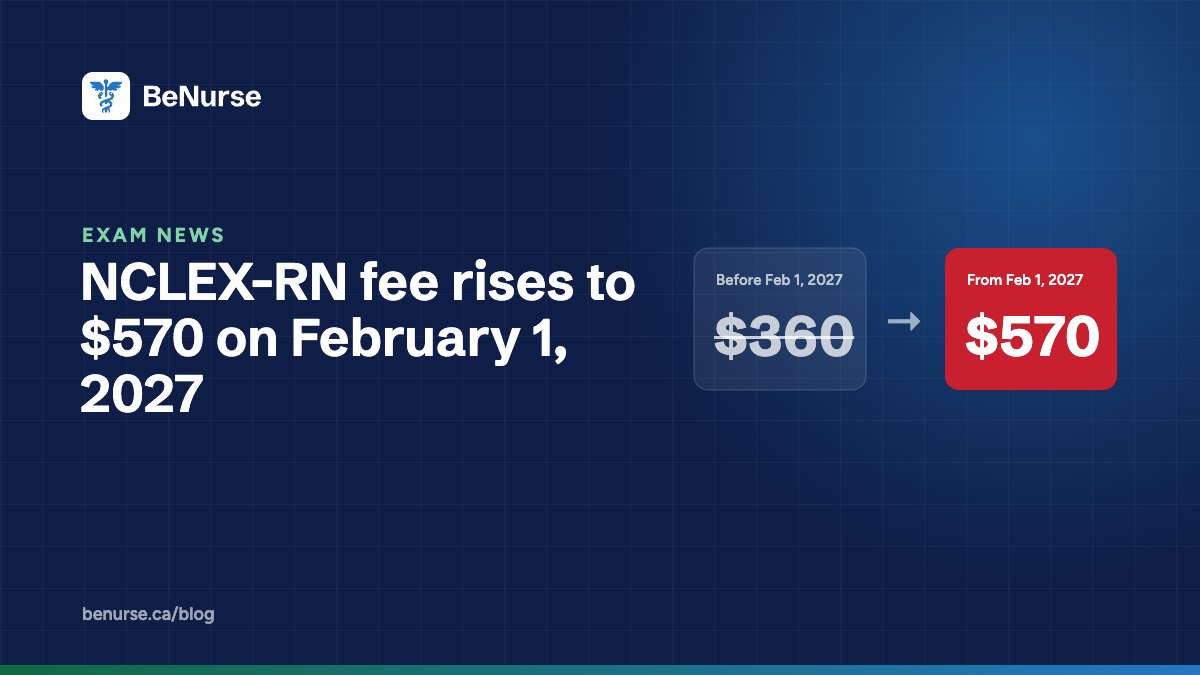
- ☐ If you have not booked yet, check the fee change taking effect on February 1, 2027.
What this does not mean for the REx-PN or CPNRE
The NCLEX-RN test plan covers the registered nurse exam only. Practical nurse candidates in Canada write the REx-PN or the CPNRE, which have their own blueprints. If you are not sure which exam applies to you, start at which exam do I write, then see the REx-PN or CPNRE pages.
For RN candidates, the takeaway is reassuring. The blueprint you are studying against in late 2026 is the same shape as the one before it, with a clearer name for infection prevention and refreshed activity statements underneath. If you want a fast read on where you stand against all eight areas, take the free diagnostic and then work through NCLEX-RN practice questions in your weakest areas.
Checked against the 2026 NCLEX-RN Test Plan (nclex.com) and NCSBN’s summary of proposed changes to the 2026 NCLEX test plans (ncsbn.org) on November 19, 2026. BeNurse is not affiliated with NCSBN, Pearson VUE or any Canadian nursing regulator.